Problem
Design engineers currently get little to no feedback on life-cycle cost factors including manufacturing failures, obsolescence, or ergonomics/automation until manufacturing reviews are held late in design cycles.
Proposed Solution
CODA will leverage manufacturing data — using data engineering methodologies and Microsoft’s Azure ML environment — to help design engineers predict manufacturing or field defects. The team is focusing on electrical design and associated cost and obsolescence issues during the end product’s life cycle.
Impact
The goal is to reduce obsolescence-related ECOs by 20% with the opportunity to save more than $1 million per year by preventing obsolescence events that cause ECOs during product manufacturing or use. By using ML models trained with past events, CODA will be able to access decades of manufacturing and production expertise during the design phase, with that expertise growing as new data is captured and engineered.
Outcome
CODA provides the tool integration, platform, and process framework to leverage AI to generate obsolescence risk based on historical manufacturing data. The CODA framework, scripts, applications, and instructions are available to MxD members. The delivered scripts represent the demonstration environment.
CODA is broken down into 4 key components: engineering workspace, integration service, data environment, and AI/ML cloud development.
Engineering Workspace. This represents the tools available to design engineers; the optional frontend for the design to be analyzed. CODA is built to integrate with all the commonly used design tools with a direct connection or a link through the integration framework. CODA was demonstrated as an add-in to the Siemens Xpedition platform for circuit card design to show results in real-time within the platform; no manual effort to extract or correlate results.
Integration Service. ITI’s Linked Intelligent Master Model (LIMM) platform provided the communication and security infrastructure required to interface with the generated ML and recommendation framework. The LIMM API provides the framework to submit the required design information through LIMM, package the format for the ML endpoint, and retrieve the results. LIMM then stores this information for each analysis such that the users can access current and historical results.
Data Environment. The system architecture includes leveraging existing data information within the Raytheon ecosystem, their suppliers, and rules/analysis generated from subject matter experts.
AI/ML Cloud Development. Microsoft Azure Machine Learning Workspace environment and development tools were used to pull together key supplier and internal historical data to calculate obsolescence using a Random Forest and k-nearest neighbors (KNN) approach. The Project Team used a combination of physical hardware, virtual machines on-premise, cloud services and storage accounts, and hosted endpoints.
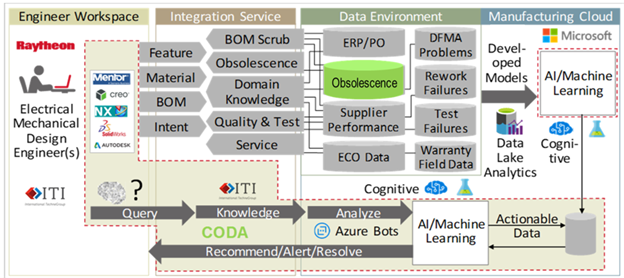
Fig.1 CODA Framework
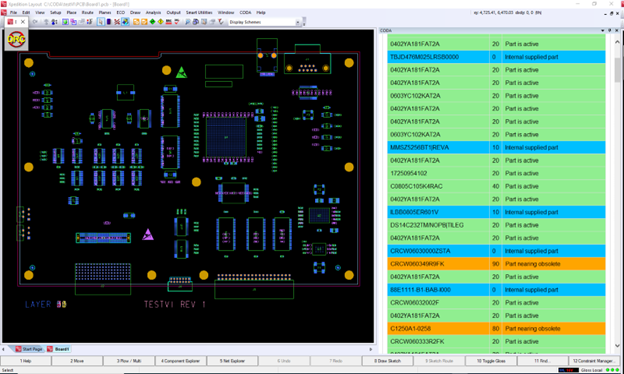
Fig.2 CODA Engineering Workspace View
Completion Date
Project Number
21-01-05
Project Lead
International TechneGroup Inc. (ITI)
Raytheon Technologies