By Mark Jacob
For MxD
About 15 years ago, Jeff Heath was a laborer in the finishing room of a northeast Indiana foundry.
“It was pretty rough,” he said. “You … just ground, ground, ground all day long. Most of the time because there’s so much grinding dust flying around, usually you’re wearing full coverage on almost everything.”
Today, Heath is a manufacturing engineer who grinds out his living on a computer much of the time.
His digital manufacturing role involves programming CNC machines to perform projects for Indiana Technology and Manufacturing Companies (ITAMCO).
The company, an SMM with facilities in Plymouth and Argos, Ind., makes high-quality gears and other parts for the defense, oil, mining and aviation industries.
How did Jeff Heath get from a laborer job to an engineering job in the digital realm? The same way you get to Carnegie Hall: Practice, practice, practice.
Heath is known to colleagues for his insatiable curiosity and his determination to learn new skills and devise better ways to operate. He is a booster for digital manufacturing.
“The intent is always to move forward,” Heath said. “I never was one to want to sit still and do the same job for 10 years or something. I get bored. You’ve got to keep growing. That’s another thing this industry [teaches]: If you’re not moving forward, you’re getting left behind.”
Heath, who grew up primarily in Indiana and lived in Chicago’s south suburbs in his early 20s, attended college “for a while when I was still young and ran into some student loan issues and hit the workforce.”
After a variety of jobs, including in real estate, Heath was hired to “grind, grind, grind” parts in the finishing room of the Rochester Metal Products foundry.
And thus began his climb in the manufacturing industry.
“Eventually they saw potential in me and asked me to start moving toward the quality [control] side,” he said.
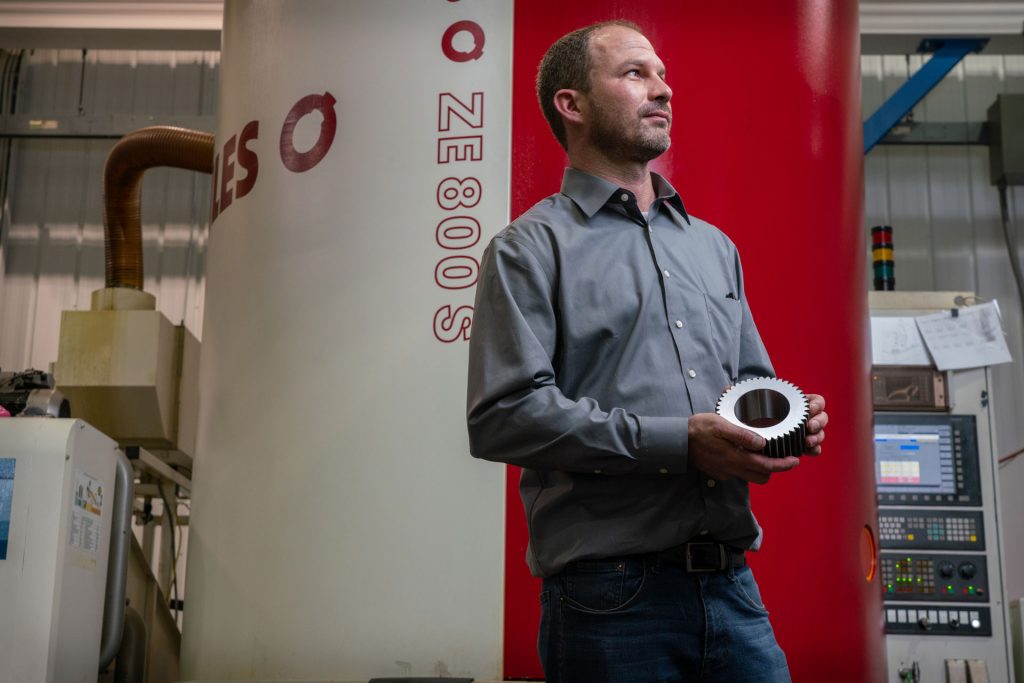
Ten years ago, he was hired by ITAMCO as an inspector, and he kept learning new things and getting new jobs within the company, including quality engineer and milling department group leader.
“In all honesty, in what I do know, it’s kind of learning on the go,” Heath said. “You can learn a whole lot from the internet these days.”
For instance, years ago he downloaded CNC simulator software and practiced on a virtual piece of steel. “I learned a lot of programming that way,” he said, describing how he has taught himself new skills in many cases.
Curiosity drives Heath, but so has necessity. Because while U.S. manufacturing shows plenty of potential, it is often buffeted by economic crosswinds.
After one particularly big downturn in business led to job cuts, Heath said those who remained needed to take on new duties to keep the business going.
“I went out and started learning how to operate the vertical and horizontal mills,” Heath said. “I really enjoyed it for a while, and I’m pretty proficient with it.”
Broadening digital manufacturing skills makes an employee more valuable. “I think in any field one can better feel a sense of security and satisfaction when you keep moving forward and encourage others to as well,” Heath said.
Before leaving college, Heath didn’t take any digital manufacturing courses. But he began exploring programming on his own and found himself more and more fascinated.
“I started doing CAD [computer-aided design] models for fun.” Heath said. “… I did it at home by myself. I would just find some object around the house and make a model of it on a computer, and I learned how to make pretty much anything with the software.”
“You don’t necessarily need a four-year college degree to learn new digital skills that advance your career,” said Liz Stuck, Head of Engagement and Workforce Development at MxD, the digital manufacturing institute in Chicago. “Jeff’s example of constant learning and on-the-job training is a very effective model for mid-career workers seeking better career prospects.”
“It’s also the kind of learning that employers must support if they’re going to upskill their workforce,” Stuck added. “Companies are already stretched thin; they can’t afford to lose workers who are pursuing educational opportunities instead of working. On-the-job training is urgently needed right now.”
ITAMCO, which began as a tool and die shop 65 years ago, got deeply into digital manufacturing in 2008 when it participated in MTConnect, a national initiative promoting the Industrial Internet of Things.
Since then, ITAMCO, an MxD partner, has adopted digital capabilities in 3D metal printing, robotics, virtual reality and blockchain. The company, which describes “a culture of learning” on its website, has helped Heath and other employees step up their digital manufacturing game.
“I’ve gotten away to a two- or three-day class here and there,” Heath said. “And we’ve actually done some here, over the years, between the two [ITAMCO] facilities. I’ve probably had somewhere in the neighborhood of 10 to 20 two-to-three-day courses.”
He also learns about new technology at trade shows. “You can see machines are getting more advanced, and for years the company has always set up a trip for a lot of the employees to go to IMTS [the International Manufacturing Technology Show].
Matt Davis, ITAMCO’s Manager of Training and Organizational Development, said Heath has soaked up a lot of information.
“I see him go and try different programs,” Davis said. “It really comes down to the personal, wanting to learn, and Jeff has really excelled and nailed that piece of it.”
Heath said that while he has no official mentoring role at ITAMCO, he tries to pass on what he’s learned to operators on the floor, to “help them grow as well.”
Heath took his manufacturing engineer position about a year ago. “Between a few of us, we do all the programming for every machine in the shop,” he said. “We also plan out how we’re going to process a job and if any special tooling and fixturing will be required.”
Davis is impressed by Heath’s approach. “He’s very driven,” Davis said. “He does all the little things right.”
But Heath is always looking for ways to get better.
“At some point it starts to seem like a plateau,” Heath said. “[But] we’ve got to keep on working and training to do it better and faster.”